
It is interesting to see how concepts, devices, experiments, and phenomena are depicted artistically in textbook illustrations. We often see that the drawings defy the laws of physics.
Here, we will discuss an incorrect (incomplete) representation of the well-known Torricelli's Evangelista Torricelli, italian physicist, mathematician and good friend of Galileo Galilei. His invention of the mercury barometer (1643 or 1644) is notable, with which he rejected the common prejudice about the fear of emptiness (lat. horror vacui). Torricelli filled a sealed glass tube with mercury and immersed the opening of the tube in a vessel filled with mercury. The mercury only partially flowed out of the tube into the vessel, and an empty space, a vacuum, was created above the mercury in the tube. Torricelli interpreted this phenomenon as atmospheric pressure acting on the surface of the mercury in the vessel and maintaining the balance of the mercury column in the tube. This experiment proved the existence of atmospheric pressure and showed how it can be measured based on the height of the mercury column. experiment that appears in countless textbooks, with no one pointing out the missing piece. Typically, textbooks include these examples: You have undoubtedly seen this:

What is incorrect about that? A mercury-filled tube is at rest and levitates???!
Why is the tube not supported in any way - can this be done? Is that possible?
Let us do an experiment using a PET bottle with the bottom removed and the cap tightly closed (like a diving caisson). Submerge it to fill with water first. Then lift the bottle so that the opening stays below the surface. We use a spring scale to figure out the weight of the bottle based on how far it is lifted out of the water:
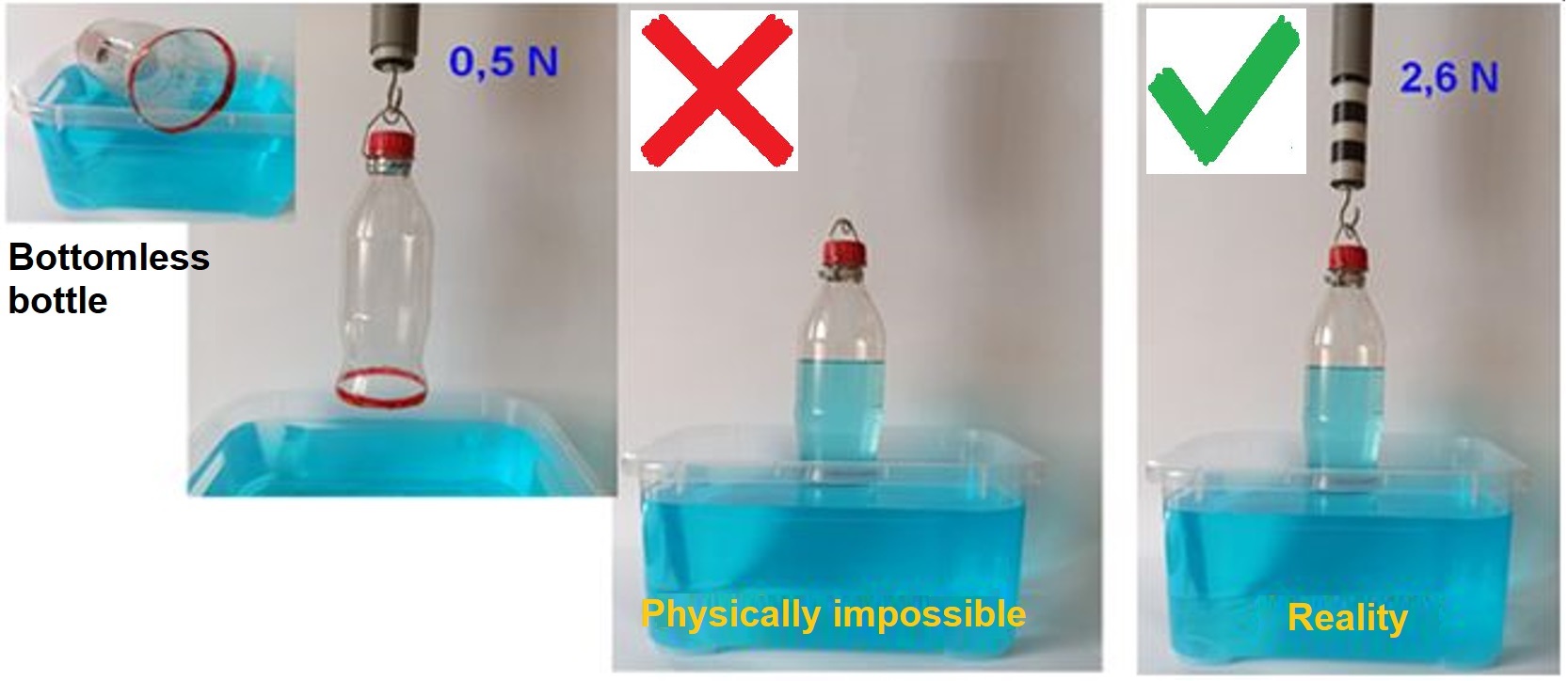
An insert photo with the spring scale digitally removed (marked with ❌) is used to illustrate this straightforward experiment. This improbable scenario at once raises suspicions of photoshopping, but no one objects when Torricelli's experiment is illustrated in the same way.
Let us perform the next demonstration. Connect a flexible rubber hose to the upper end of a glass tube that is open on both ends, then submerge the lower end of the tube in mercury. The entire assembly is then suspended from a spring scale. As depicted in the drawing, attach the other end of the hose to the vacuum pump.

When the pump was turned on, the mercury in the tube began to rise until it reached a height of ≈760 mm. During suction, the reading on the spring scale increased as the weight of the rising mercury column increased. The standard explanation provided in textbooks is that the mercury column is supported by the air pressure exerted on the mercury's surface in the bowl.
And we can see that the mercury column, along with the glass tube, is hanging like a weight on the spring scale.
The question that arises is whether it is correct to say that:
- the mercury column hangs from a spring scale or
- the mercury column is supported by the atmospheric pressure
- or both statements are correct?
Torricelli clearly removed his finger from the orifice of the glass tube, but he DID NOT release the tube from the hand in which he was holding it! Since the tube is not supposed to levitate, as most reputable textbooks depict.
A proper illustration would be as follows:
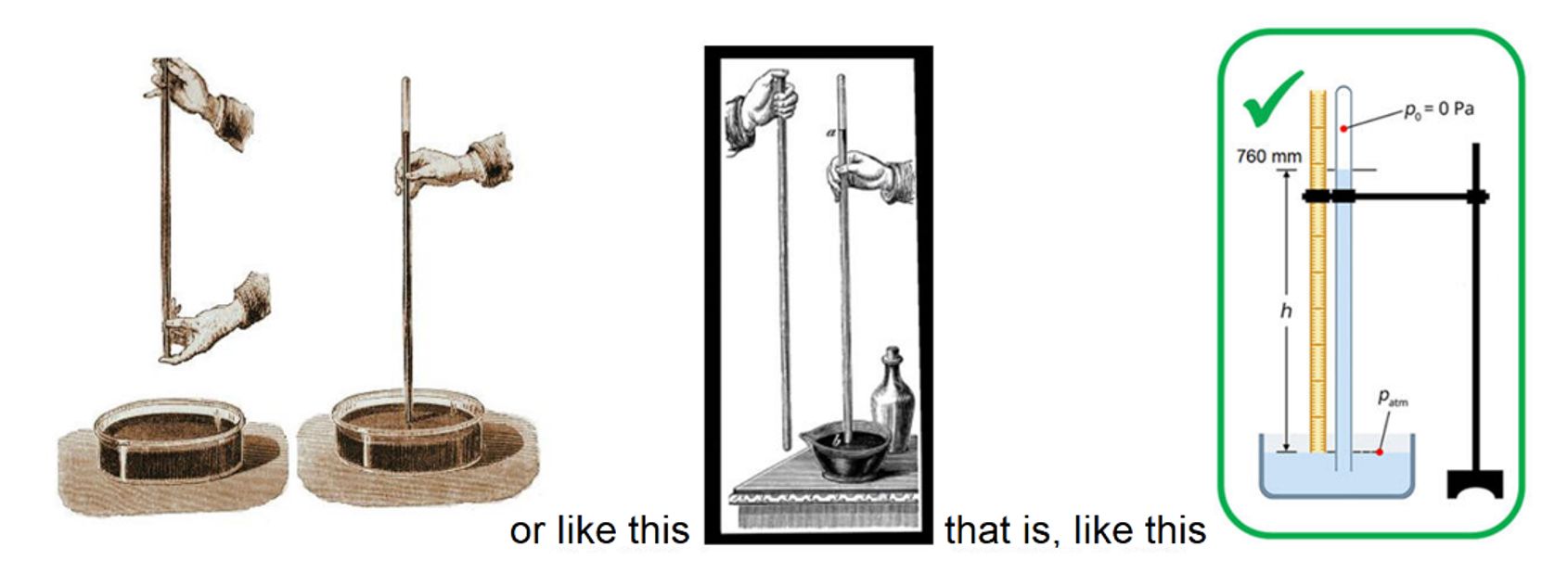
Imagine that we release a Torricelli's tube filled with mercury from our hand into a deep mercury pool. The tube would immediately begin to sink until its buoyancy was equal to its weight. Therefore, it is important to take into account Newton's first law which states that resting is the outcome of canceling all the forces acting on an object. Allowing that textbook illustrators know this and try just to simplify the illustration by emphasizing the essential, this should not be done at the expense of the necessary equal opposing force acting on the same object.

The addition of a stand to hold the tube does not detract from the illustration's clarity:
Conclusion

Finally, what can we say about atmospheric pressure's role?
It is obvious that the mercury column does not descend due to atmospheric pressure, and that without that pressure, the mercury would completely leak out of the tube. After all, that’s why the mercury column functions as atmospheric pressure gauge called barometer. However, atmospheric pressure is only a "plug". In Torricelli's original experiment, the mercury stopped flowing out, as if someone had closed the opening of the tube again with their finger. Without that clogging effect, the mercury, which only slightly wets the glass, would be unable to pull the tube and load the spring scale as in the vacuum pump experiment described here. We can imagine or perform the removal of both the atmospheric pressure and the mercury container, and replace them with a stopper at the bottom opening of the glass tube. The mercury column's height will not change, but the tube (having mercury) must still be held by hand or a clamp on the stand.
And now for the final word. Should we say that the mercury column hangs on the spring scale or is it held in place by atmospheric pressure? Both is the answer. Both assertions are valid and physically justifiable, thus the force that cancels the weight of the mercury in the tube should not be left out of the figure.
Poultry drinker.
The inverted bottle does not float, it is secured with clamps.
If we swap out the water pan and atmospheric pressure with a cork and vacuum, nothing will change.
Hrvoje Mesić
