The expressions 'pressing force' and
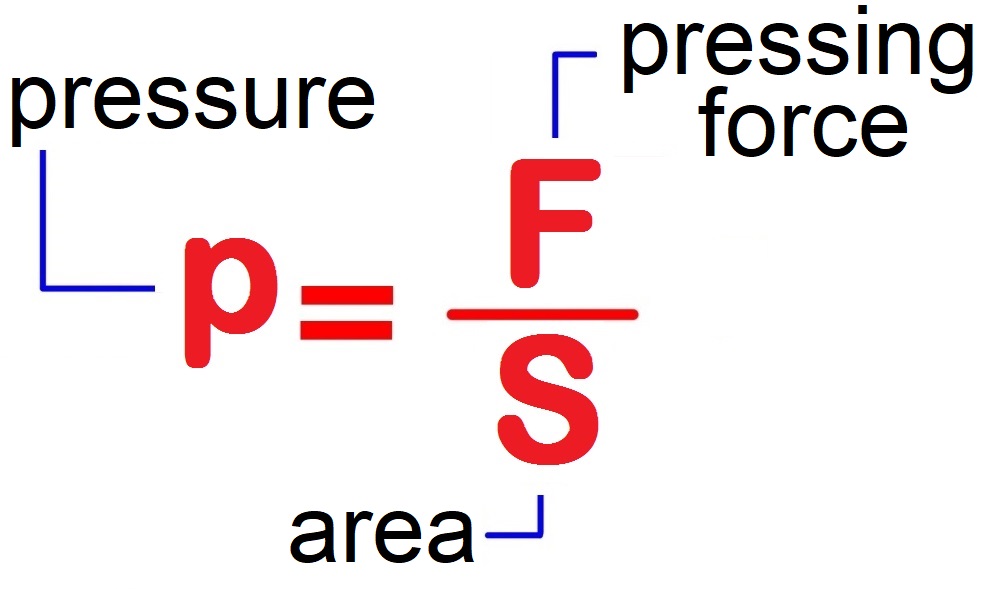
'pressure' are not synonyms, but are used for different physical phenomena. Pressing force is measured in newtons [N], and pressure is the quotient of the force and the surface on which that force acts and is measured in pascals [Pa]. If we take a brick weighing mg , we can lay it like a block on a soft surface (e.g. sand, dough, plasticine) in three ways. The pressing force in all three cases will be the same mg. However, the footprint that the brick will leave on the substrate will be of different depths.
It is immediately seen that the depth of penetration is inversely proportional to the surface S , the smaller the surface, the higher the pressure.
Pressure is the ratio of pressing force to surface area
The difference between pressing force and pressure can easily be demonstrated by an experiment in which we hold a nail between the index finger and the thumb. The tip of the nail has a very small surface compared to the surface of the nail head. The pressing force on both sides is equal, but the pressure at the point of the spike is so great that we feel a sting because it penetrates deeper into the skin.
One of the consequences of the above is that we can get a very large pressure with a small force, reducing the area on which that force acts. We can also increase the area to produce a small pressure even though the force is great. For this reason, the blade of a knife acts with greater pressure when the knife is sharp, or a nail penetrates wood more easily with a sharp tip, or we use snowshoes or skis to move through snow without falling, or the floor suffers more if you walk on it in high heels than if you do it in slippers.
What is 1 Pa?
The unit for pressure is the pascal (Pa) and by definition it is 1 N per 1 square meter. If we take a container with a bottom area of 1 m² we can pour so much water into it that its weight will be 1 N. Then the pressure on the bottom of that container will be exactly 1 Pa. How much water should be poured to achieve this and what will be the thickness of the layer of water when it evenly covers the entire bottom of the container?
One liter of water has a mass of 1 kg, that means a weight (mg) of 10 N. So, to have a weight of 1 N we need a ⅒ of a liter or one deciliter (0.1 ℓ) of water. After a deciliter of water is spread evenly over the bottom of our square meter, we will get a layer with a thickness of 0.1 mm. A layer of water of a tenth of a millimeter creates a pressure of 1 Pa! So small is Pascal. It seems that it is enough to wipe a surface with a wet cloth and you get a pressure of one Pascal.
In meteorological reports rainfall 🔎 When the amount of rain appears in the meteorological report, it is expressed by the height of the water layer in millimeters per square meter. Precipitation of 1 mm means that one liter of water fell on every square meter. For example, if it is said that 40 mm of rain fell, it is the same as if it were said that for every m² fell 40 liters of rain. is expressed by the height of the water layer in millimeters.
Fluid column pressure
The liquid exerts pressure on the bottom of the vessel due to its weight mg, therefore the pressure on the bottom is the ratio of this weight and the bottom area S. In the further derivation, the area is shortened and we get expression that shows that the pressure at a certain point of the liquid does not depend on the geometry of the vessel except for the depth.
This pressure is called
hydrostatic pressure 🔎 Hydrostatic pressure is the pressure inside a still liquid, due to the weight of the liquid and increases linearly with the column height of the liquid above the observed point
it does not depend on the shape of the container, nor on the amount of liquid in it, but depends exclusively on the density of the liquid ( ρ ) and the column height ( h ), that is, the depth in the liquid and its density:
p = ρ g h
However, this is not the only pressure to consider, as the vessel containing the liquid is normally exposed to the atmosphere, whose air mass also exerts pressure on the surface of the liquid, and thus the pressure. Therefore, the pressure at a point inside the liquid will be the sum of the hydrostatic pressure due to the column of liquid above that point, plus the external (atmospheric) pressure on the surface. This is the fundamental principle of hydrostatics: p = po + ρ g h.
Hydrostatic paradox
Hydrostatic paradox 🔎PARADOX [gr. Παράδοξος = unexpected, strange] is an opinion, a judgment that differs from the usual, generally accepted, goes against (sometimes only at first glance) common sense; an unexpected phenomenon that does not correspond to the usual ideas in science. is the fact that the liquid pressure forces on the bottom of different containers filled to the same height with the same liquids are always the same regardless of the amount (volume, weight) of the liquid. Containers of the same height only differ in shape - a conical container can hold a smaller amount of liquid, and a container that expands upwards can hold a larger amount of liquid.
The picture shows three glass cylinders of different shapes with the same bottom opening areas, but different diameters of the upper parts. A tiles attached to dynamometers tensioned to the same force (3 N) adheres to the lower opening of each cylinder. It is obvious that if any liquid is poured into these containers and the pressure force of the liquid exceeds this force (3 N), the spring of the dynamometer will give way and the liquid will flow out. But the experiment shows that the pressure on the bottom will be exactly the same and the springs of the dynamometers will keep the bottom closed in all three containers to the same level of liquid.
At first glance, we would expect that the pressure on the bottom of the middle container will be the lowest, and on the bottom of the right - the highest. This assumption is refuted by the experiment because the dynamometers show the same pressure force, which means the same hydrostatic pressure in all three vessels. We conclude: The pressure of the liquid on the bottom of the container does not depend on its shape! Why is it paradoxical to us? This is because we intuitively mistakenly perceive a liquid at rest in a container as a solid object. If we froze the water from the upper cylinders and hung the ice of those shapes on the dynamometers, nothing would be paradoxical, because the readings of the dynamometers would be expected to differ:
The difference between the weight of the liquid and the force of pressure on the bottom is caused by the reaction forces of the walls, so in a container that narrows upwards, these forces act on the liquid diagonally downwards (pressing the liquid to the bottom), while in a container that expands they act on the liquid diagonally upwards ( make the liquid lighter).
The fact that the pressure in the liquid also acts upwards is shown by Gravisand's experiment which requires a really minimal equipment (a tube with a ground edge and a smooth plate a). We press the plate with our hand on the lower opening of the tube and hold it with a tied thread b. Then we immerse the tube in water. If we let go of the thread and stop holding the tile, it will remain pressed due to the pressure of the liquid c. To check, we pour colored water into the tube d and see to what level it should be poured in order to equalize the pressures and separate the tile e.
The physical meaning of this paradox is that the weight of the liquid in the container is different from the pressure force on the bottom (for the middle and right containers).
How to "reconcile" our assumption about the mass (weight) and the result of the experiment?
The pressure at the bottom of each vessel can be calculated using the formula p = ρ g h. If the same liquid is poured into containers to the same level, the pressures will be equal, because the heights of the liquid columns are equal.
The force with which the liquid presses the bottom of each vessel can be calculated from the formula F = pS. Inserting the expression for pressure, we get: F = ρ g h S. All values on the right-hand side of this equality are the same for all three vessels. It follows that the forces acting on the bottom of all three containers will also be equal. Namely, this formula contains neither the mass nor the weight of the liquid, so we can conclude that the pressure forces on the bottom of the container do not depend on these values.
Communicating vessels
The hydrostatic paradox can be clearly demonstrated by communicating vessels. These are containers interconnected by liquid passages and have a common bottom. In them, the surfaces of a homogeneous liquid at rest are at the same level, regardless of the shape and size of the individual container. Because the pressure on the vessel walls is equal at any horizontal level.
Dependence of hydrostatic pressure on depth
Liquids act by pressure both on the bottom and on the walls of the container. And that pressure depends on the depth, which can be easily demonstrated by the outflow of the jets from the holes on the vessel and by comparing their ranges on the ground, which should be sufficiently lower than the lowest opening of the vessel itself.
Water tower
The water tower is a facility in the water supply network of lowland settlements. It is a tank raised high above the ground to store drinking or industrial water. With an elevated tank, not only a temporarily sufficient amount of water is achieved, but also sufficient and uniform pressure in the water supply network. Pressure oscillations on the inlet side (filling) and water consumption fluctuations on the outlet side (discharge) are compensated by the height and water supply. The result is a lower load on the filling pump and the creation of pressure in the supply network.
For sufficient pressure, all consumers must be lower than the tank of the water tower (principle of communicating vessels). Discharge points that are higher than the water tower level, such as tall buildings, require their own booster pump system
Liquid column pressure and atmospheric pressure
In addition to liquids, pressure also exists in others
fluids, as well as in air. The first proof of atmospheric pressure was performed by the Italian physicist Torricelli 🔎Torricelli, Italian physicist, mathematician and good friend of Galileo Galilei. His invention of the mercury barometer (1643 or 1644) is notable, with which he rejected the common prejudice about the fear of emptiness (lat. horror vacui). Torricelli filled a sealed glass tube with mercury and immersed the opening of the tube in a vessel filled with mercury. The mercury only partially flowed out of the tube into the vessel, and an empty space, a vacuum, was created above the column of mercury in the tube. Torricelli interpreted this phenomenon as atmospheric pressure acting on the surface of the mercury in the vessel and maintaining the balance of the column of mercury in the tube. This experiment proved the existence of atmospheric pressure and showed how it can be measured based on the movement of the mercury column.. He filled the tube (actually a long test tube) to the top with mercury, closed the opening with his finger and turned the tube with the opening downwards. Keeping his finger on the opening, he dipped that end of the tube into the container of mercury. When the opening was immersed, he removed his finger and let the mercury flow out. Soon the mercury stopped flowing out at a column height of 760 mm. The air pressure on the surface of the mercury in the container equalized with the pressure of the column in the tube. Since then, the height of the mercury column has served as a barometer. Atmospheric pressure acts on the height of the column and without this pressure the mercury in the tube would completely leak out. However, when Torricelli removed his finger from the opening of the tube after the mercury immersion, he did NOT let go of the tube from the hand he was holding. So should we then say that the column of mercury holds the atmospheric pressure or that Torricelli held it with his hand? The answer is in the article: Torricelli and 1st Newton's Law.
If we include the values ρHg = 13600 kg/m³; g = 9,81 m/s²; h = 0,76 m in the expression for the pressure of the liquid column p = ρ g h we will get a value of 101325 Pa. It is the pressure of the column of mercury which, due to the balance with the air pressure, is also the atmospheric pressure. This proved that the atmospheric pressure can balance the mercury column pressure.
If Torricelli had used water instead of mercury, the column that would balance the air pressure would have been 13.6 times higher (as many times the density of water is less than mercury), that is, it would have had a height of about 10.3 m.
An inverted glass
A favorite experiment with the topic of air pressure consists of a glass beaker filled to the brim with water, which is covered with thin cardboard (eg. postcard) and then turned upside down. The question of whether the postcard will fall off or whether it will remain close to the opening of the glass will not instinctively always give a correct answer, even from physicists who are not familiar with the experiment. As we can easily show, the postcard remains adhered.
The usual explanation of the experiment is as follows „... that the pressure of the air acting from below is much higher than the pressure of the water column in the glass!“. We know that air pressure at sea level corresponds on average to the pressure of a column of water approximately 10 m high. Since the postcard is pressed against the glass by such a large external air pressure, it can easily hold a small column of water in the glass.
If we start from this statement, the cover tile for a glass of radius r = 2.5 cm therefore, when the water pressure is neglected, with the accepted air pressure of p = 1,013 • 105 Pa it should be able to withstand the pulling load of
F = pπr² = 199 N
i.e. almost 200 N. And that corresponds to a mass weight of 19.9 kg, which, after deducting the mass of the tile itself, should be able to be hung on the tile. However, the tile can be removed relatively easily, and the maximum loads it can bear are more than 10 times lighter than theoretically obtained, hence the explanation of the much higher pressure from the outside, remains questionable.
If we try to perform the inverted glass experiment with ethyl alcohol instead of water, we will see that it fails and that the postcard will not be retained. This shows us in which direction to look for an answer. Namely, alcohol has several times less surface tension than water.
Blood pressure
Like water in a plumbing system, blood in the bloodstream is under pressure. In this way, it comes from large blood vessels and into the thinnest capillaries.
The heart acts like a pressure-suction pump, which rhythmically contracts and relaxes again. As a consequence of this way of working, blood is not pushed into the vessels continuously, but in spurts. That is why two values are always determined when measuring blood pressure:
Upper - Systolic blood pressure
The phase in which the heart muscle contracts and pushes blood into the arteries is called systole. The pressure at which the artery wall briefly expands is known as the upper or systolic blood pressure. We can also feel this pressure wave as either (pulsation) by feeling a vein on the neck or wrist.
Lower - Diastolic blood pressure
During diastole, the heart muscle relaxes again and blood can flow back to the heart through the veins. During this brief phase of relaxation, the pressure in the vessels is understandably reduced. The diastolic blood pressure value is always lower than the systolic value and is also called the lower measured value.
Even today, blood pressure is expressed in units of mmHg - millimeters of mercury - since it was originally determined using a mercury column. One millimeter of mercury column equals 133 Pa. The first given value is always the systolic measured value (upper pressure), the second value describes the diastolic (lower) blood pressure.
The optimal blood pressure value measured at rest is 120/80 mmHg. But slightly higher values are still considered normal. Only above 140/90 mmHg do doctors speak of elevated blood pressure, which is professionally called arterial hypertension 🔎With regard to the measured values of arterial pressure in the doctor's office, arterial pressure is classified as
• optimal (<120 / <80 mmHg )
• normal (120-129 / 80-84 mmHg )
• normaly high (130-139 and/or 85-89 mmHg)
•1st degree hypertension (140-159 and/or 90-99 mmHg)
•2nd degree hypertension (160-179 and/or 100-109 mmHg)
•3rd degree hypertension (≥180 and/or ≥110 mmHg)
• isolated systolic hypertension (≥140 / <90 mmHg).
.
Both upper and lower blood pressure are constantly adjusting to the demands of our body. During physical exertion, the heart pushes more blood into the body, which increases the pressure. Blood pressure also increases with stress and excitement. By slower or faster heartbeats and narrowing or widening of blood vessels, blood pressure optimally adapts to different situations in our life. This regulation of blood pressure is vital for our body.
Wind pressure
Wind is the movement of air over the Earth's surface, caused by unequal heating of the Earth's surface, which leads to differences in the pressures of different areas. Wind strength can vary from a light breeze to hurricane force and is measured on the Beaufort wind scale.
Wind pressure or wind power is an important quantity when calculating the effect of wind on an object, for example large surfaces, buildings or bridges. The dynamic pressure is the product of the aerodynamic coefficient c (depending on the shape of the object) and the wind stagnation pressure. The force is obtained by multiplying the pressure and the surface area of the object.
Numerical simulation: A crosswind (100 km/h at a height of 10 m) hits a truck while driving. The truck is 4 m high and 8.5 m long and has a closed cargo area. Overpressure is created on the windward side (left side) due to air compression, and negative pressure on the leeward side. This can cause the truck to overturn. With a wind speed of 100 km/h (27.7 m/s) and an aerodynamic drag coefficient c = 1.05 for the shape of a cuboid, the lateral force on the truck is about 16800 N.
Wind power, in some climates, can reach hurricane proportions and leave dramatic destructive effects. Such natural disasters can wipe out entire settlements from the face of the earth, especially in poor areas where houses are built mainly from cheap, light materials.
Magdeburg hemispheres
At the time of the emergence of experimental science, in the 16th century, many scientists debated the question of whether there really is an empty space. Even the mayor of Magdeburg (and a physicist) Otto von Guericke 🔎Otto von Guericke (Magdeburg, 1602. – 1686.), German physicist and engineer. He invented the air pump in 1650 and founded vacuum physics. His experiment from 1654 in Magdeburg is well-known, when 50 people could not lift the lid of the kettle from which air was sucked with his suction pump. Guericke was engaged in research on the connection between the state of the barometer and atmospheric conditions, the astronomy of comets and the use of electricity in obtaining light. He is also known for the fact that in 1672 he was the first to observe the phenomenon of electric repulsion of the electric charge of the same name, and in 1663 he constructed the first electrostatic friction machine (a type of electroscope). dealt with this question.
„Weil die Gelehrten nun schon
seit langem über das Leere, ob es vorhanden sei, ob nicht, oder was es sei, gar
heftig untereinander stritten (...) konnte ich mein brennendes Verlangen, die
Wahrheit dieses fragwürdigen Etwas zu ergründen, nicht mehr eindämmen
(...)"[1]
„While scholars, for quite a long time now, have been vigorously arguing with each other about the void, whether it exists, or does not exist, or what it is at all (...) I could no longer hold back my burning desire to grasp the truth of that doubt to some extent (...)"
[1] Experimenta nova (ut vocantur)Magdeburgica De Vacuo Spatio
Model of Magdeburg spheres for school experiments in physics, their diameter is about 10 cm, so they can be disassembled with a force corresponding to a weight of about 75 kg.
The hemispheres are pressed together with a seal at the joint. After the air is sucked out of them with a vacuum pump (the empty space in them is a relatively rough vacuum), the external pressure creates a force that prevents them from being disassembled.
hemispheres filled with air and after vacuuming
Guericke's spectacular vacuum experiments began in 1650 and made him a famous physicist and engineer. The culmination of his distinguished research series was an experiment on the effect of air pressure: the Magdeburg hemisphere.
The demonstration of his famous experiment was performed for the first time in 1657 in the city of Magdeburg:
For this purpose, Guericke used a vacuum pump to exhaust the air from two hollow copper hemispheres, which were sealed at the joint with a leather seal soaked in oil and wax, and had a diameter of 42 cm. The air acting on the hemispheres from the outside pressed the halves together. To show how much pressure the atmosphere causes, Guericke harnessed eight horses to each hemisphere, and they were unable to separate the hemispheres.
What is the horse's pulling force?
friction
Depending on the friction under the hooves, the horse can pull with a force always less than its own weight. The force of friction is generally the product of the pressure on the surface (i.e. the weight of the horse) and the coefficient of friction which depends on the surface (grass, asphalt, ice, gravel) and ranges between 0.2 and 0.4. So a 700 kg shod horse can pull with about 1500 N on dirt, but it cannot pull at all on ice.
Guericke wrote in his main work "Experimenta nova (ut vocantur) Magdeburgica De Vacuo Spatio":
[1] translation: [ „Only with a leather ring as an insert, those hemispheres are pressed against each other, and then the air is...suddenly depleted. I saw then, with how much force both hollow halves pressed to insert the ring! And under the action of air pressure, they remained so firmly attached to each other, that even 16 horses could not separate them, or separated them only with great difficulty. If sometimes, but with the greatest effort, they manage to separate them, then a shot rings out as if from a flintlock rifle". ]
With his experiments, he disproved the then-prevailing belief about "Horror vacua" (lat. Fear, horror of emptiness), the so-called nature's fear of emptiness, which people at that time used to explain, among other things, the principle of pumping with suction pumps. Guericke showed that empty space really exists and how man can realize it. At the same time, it was clarified that air, like any other object, has weight. And according to this, the Magdeburg hemispheres are not "attracted to each other by the internal vacuum", but due to the high air pressure from the outside, they are pressed against each other.
Calculation of the force required to separate the hemispheres
Atmospheric pressure crushes the can
CAUTION! HIGH TEMPERATURE! In this experiment, heated objects are used
to high temperature!
Everyone has probably already crumpled a drunk can of some refreshing drink with their hand. Of course, it wasn't difficult because the can is empty and is made of thin aluminum sheet, so it easily bends under the pressure of the hand.
However, an interesting and simple experiment will show us that a can can be crumpled in a completely unexpected way due to atmospheric pressure.
Pour water into the empty can, but no more than one finger (about 0.3 dl).
Then put the can on a gas or electric stove and let the water boil.
If the water in the can is boiling, it will be seen by the cloud of condensed water vapor above the opening. Let it boil for 20 to 30 seconds, so that the inside of the can is completely filled with steam.
While we wait for the water to boil, prepare a shallow bowl with cold water. The depth of the water in that bowl should be 2 - 3 cm.
Using a cloth or a glove, so as not to burn yourself, take the can off the stove and quickly immerse it, turned upside down, in cold water, so that the water covers the entire opening (see the animation on the right).
At the same time when the can comes into contact with cold water, some invisible force will crumple it so quickly that it will almost fall out of our hands.
Why did this happen? Why is boiling water needed? Would the experiment work with only air in the can?
In an open can, the pressure is equal to the external pressure. For a successful experiment, it is crucial that the can be filled with water vapor. Upon sudden cooling, in contact with water, the steam condenses and immediately turns into a liquid state. At the same time, its volume decreases about 1600 times !!! The can is then almost empty, as if vacuumed. We might expect the water from the container to fill the can. A little water may enter, but the pressure in it drops so quickly that the water, due to its viscosity, cannot enter through the relatively narrow opening. That's why the pressure difference tends to crush the can.
Let's estimate how much force was acting.
Assume that the temperature of the hot gas in the can is T1 ≈ 370 K (97 ℃), and that the atmospheric pressure inside is p1 ≈ 105 Well. By sudden cooling, let the temperature drop to T2 ≈ 300 K (27 ℃). This means that with unchanged volume (isochoric change), the new pressure p2 will be obtained from the constancy of the ratio of pressure and temperature:
p1/T1
=
p2/T2
⟹ p2 = p1
T2/T1
If we include the assumed values, we will get the approximate amount of pressure after cooling:
p2 = 105
300 K/370 K
Pa ≈ 81000 Pa
that is, the difference between the pressure outside and the pressure in the can is Δp ≈ 19000 Pa
From the diameter and height of the can, which has the shape of a cylinder, it is easy to calculate its surface area, which is about 3 dm².
Since force is the product of pressure and surface area, we arrive at the amount of:
F = Δp·S = 19.000 Pa ·3·10-2 m2 = 570 N
A force of 570 N corresponds to a body weight of about 60 kg!
The above calculation is valid only for gases that would remain gaseous after cooling, eg air. However, the water vapor turns into a liquid condensate upon cooling, and this condensation occurs quickly. The air would cool slowly and would not reduce its volume 1700 times but only by 1/5. Water vapor volume 330 cm³ by changing to a liquid state, it reduces the volume to only 0.2 cm. Assuming that all the vapor in the can condenses, which is probably not the case.
For our can, this means a pressure change of about 10⁵ Well, what by multiplying by an area of 3 dm² gives a force of 3,000 N. This force corresponds to the weight of a body with a mass of approximately 300 kg!
Remark:
Where did the 1700 times volume reduction come from?
A mole is a measure of the amount of a substance. We will have one mole of any substance if we take as many grams of that substance as its relative atomic or molar mass. For water, this means that 1 mole of water has 18 grams, (H2O = 2 hydrogen atoms (2 × 1 g/mol) and 1 oxygen atom (16 g/mol)). Those 18 g of water have a volume of 18 ml (density of water is 1 g/cm³). When liquid water turns into steam (gas), then a mole of gas at a temperature of 373 K or 100 ℃ occupies a volume of 30.6 liters (at a pressure of 105 Pa). And 30.6 liters is 30600 ml. That is 1700 times more than 18 ml of liquid.
If we include the following values in the gas equation p·V = n·R·T: number of moles n = 1; pressure p = 105 Pa; temperature T = 373 K; gas constant R = 8.314 J/mol·K
we can calculate the volume of one mole of steam:




 Torricelli, Italian physicist, mathematician and good friend of Galileo Galilei. His invention of the mercury barometer (1643 or 1644) is notable, with which he rejected the common prejudice about the fear of emptiness (lat. horror vacui). Torricelli filled a sealed glass tube with mercury and immersed the opening of the tube in a vessel filled with mercury. The mercury only partially flowed out of the tube into the vessel, and an empty space, a vacuum, was created above the column of mercury in the tube. Torricelli interpreted this phenomenon as atmospheric pressure acting on the surface of the mercury in the vessel and maintaining the balance of the column of mercury in the tube. This experiment proved the existence of atmospheric pressure and showed how it can be measured based on the movement of the mercury column.


 Otto von Guericke (Magdeburg, 1602. – 1686.), German physicist and engineer. He invented the air pump in 1650 and founded vacuum physics. His experiment from 1654 in Magdeburg is well-known, when 50 people could not lift the lid of the kettle from which air was sucked with his suction pump. Guericke was engaged in research on the connection between the state of the barometer and atmospheric conditions, the astronomy of comets and the use of electricity in obtaining light. He is also known for the fact that in 1672 he was the first to observe the phenomenon of electric repulsion of the electric charge of the same name, and in 1663 he constructed the first electrostatic friction machine (a type of electroscope).


